
2023 Trial: Knee Pain Fell ~62% Over Three Years After Adipose Therapy, Ahead of Saline
How Does Adipose Therapy Compare With a Saline Injection?
If you’re weighing adipose therapy for knee osteoarthritis, many studies have shown patients reporting less pain and better function after treatment. A natural next question is how those results look beside a group of patients who received a different injection over the same period: how does adipose therapy compare with a saline or “control” injection?
Different study designs answer different questions. Studies that follow treated patients over time show how much they improved and how long that improvement lasted. A study with a comparison group adds a second view, setting one group’s results beside another’s at every visit.
So when you weigh an injection made from your own biology, three things matter: how much better patients got, how long it lasted, and how they fared compared with patients who received saline.
A 2023 controlled trial published in the Indian Journal of Orthopaedics by Tantuway and colleagues was built around that comparison. It followed 116 patients with knee osteoarthritis — 231 knees in all — for three years. About half the knees received a single injection of cells isolated from the patient’s own adipose tissue. The other half received a single injection of saline, a sterile salt-water solution. Every knee was then followed to the three-year mark.
Your Own Biology, Measured Against Salt Water
Osteoarthritis wears away the cartilage that cushions the ends of the bones. The joint stiffens, swells and aches, and everyday movements — stairs, rising from a chair, a long walk — start to cost more than they used to.
The usual path runs through physiotherapy, anti-inflammatories, cortisone and hyaluronic acid injections, where relief is often temporary. Joint replacement can be effective for many people, but it’s major surgery, generally reserved for advanced disease and is irreversible. Between the two sits the treatment gap. Many patients live there for years.
Adipose tissue — the fat your body stores — is one of the body’s richest sources of biological material. Beyond fat cells, it holds stem cells, cells from the walls of small blood vessels, immune cells and a supporting matrix. In this trial, that biology was concentrated into what’s called the stromal vascular fraction. Fat was taken from the abdomen, processed and injected into the knee in the same sitting. No enzymes or laboratory culture were used.
The saline group is what sets this study apart by allowing for comparison. Alongside the improvement in treated knees, it shows how a second group of knees fared over the same three years, so the two can be read side by side: knees that received the patient’s own fat tissue, and knees that received salt water. Here’s what each group did.
Learn More About Regenerative Matrix Therapy™
Study Overview: One Injection of Adipose Cells or Saline, Followed for Three Years
Study Design: Prospective, two-arm controlled trial, described by the authors as a double-blinded randomized controlled trial. The 231 knees were assigned in sequence: the first 115 to adipose therapy, the remaining 116 to saline.
Participants: Adults aged 45 to 85 with knee osteoarthritis and knee pain for more than six months, who had difficulty with at least one everyday task such as climbing stairs or rising from a chair. Excluded: knee deformity over 10 degrees, knee surgery in the previous 12 months, inflammatory arthritis, and a cortisone or hyaluronic acid injection in the previous three months.
Sample Size: 116 patients and 231 knees. Adipose group: 58 patients, 115 knees. Saline group: 58 patients, 116 knees. The paper reports no patients lost to follow-up; all 231 knees were analysed at 36 months.
Severity Mix: Kellgren–Lawrence grades 1 to 3, mostly grade 3 (moderate osteoarthritis). Adipose group: 49 of 58 patients (84.5%) grade 3, 8 grade 2, 1 grade 1. Saline group: 50 of 58 patients (86.2%) grade 3, 6 grade 2, 2 grade 1. Grade 4 (bone-on-bone) knees were not included.
Intervention: A single injection into each knee of autologous adipose tissue-derived stromal vascular fraction (SVF): about 200–300 cc of abdominal fat harvested under sedation or short general anaesthesia, broken up by ultrasonic cavitation and centrifuged, without enzymes or culture. Each knee received 5–8 cc. Antibiotics, and anti-anxiety or opioid pain medication if needed, were given beforehand. The whole procedure took 60 to 90 minutes in the same sitting, as an in-patient procedure.
Comparator: A single injection of 5–8 cc of saline into each knee. The paper does not describe whether saline patients had sedation or any harvest procedure.
Follow-Up: 1, 3, 6, 12, 24 and 36 months, in person or by telephone or email.
Endpoints: No primary endpoint was designated. Pain on a 0–10 visual analogue scale (VAS; lower = better) and the Knee injury and Osteoarthritis Outcome Score (KOOS; 0–100; higher = better), which captures pain, stiffness, everyday tasks like stairs and rising from a chair, and quality of life. Both were compared within each group against baseline and between groups at each visit.
Key Findings: A Large Drop in Pain That Was Still Present at Three Years
1. In the Adipose Group, Pain Fell by ~62% Over Three Years
The paper didn’t name a single primary endpoint. It tracked two patient-reported scores at every visit: pain on a 0–10 scale, where lower is better, and the KOOS, where higher is better.
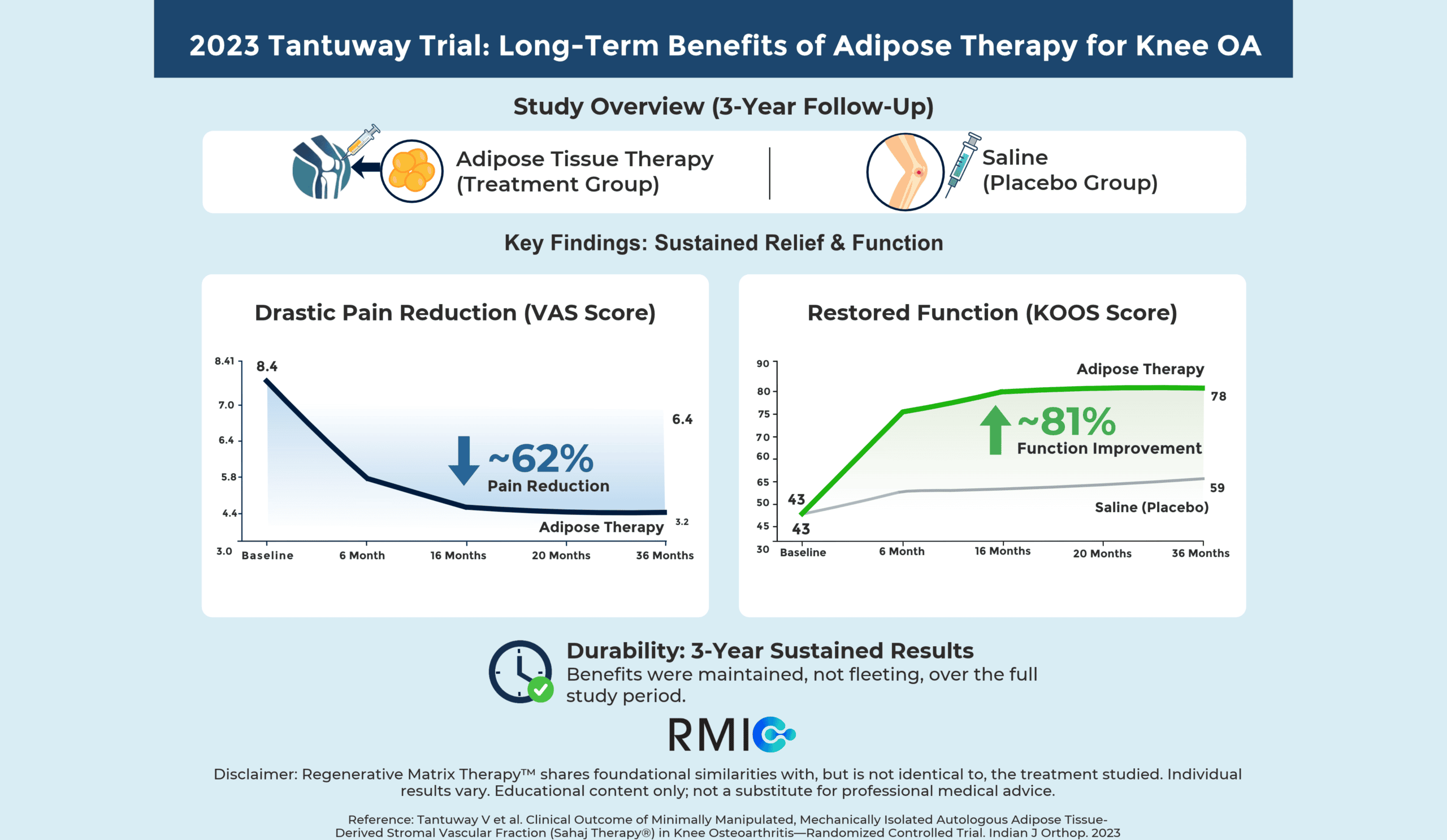
In the knees treated with adipose therapy, average pain fell by ~62% (8.41 → 3.17 out of 10 at 36 months; p = 0.001), a drop of ~5.2 points. The KOOS score improved by ~35 points (43.25 → 78.49; p = 0.001).
For many patients, a score above 8 is pain that’s hard to think past, while a score near 3 is pain that’s present but no longer in charge. That may be the difference between avoiding the stairs and taking them without thinking.
2. Relief Built Over the First Months and Was Still Present at Three Years
Pain in the adipose group began to ease within the first month (7.72 at 1 month) and kept falling: 6.71 at 3 months, 5.29 at 6 months and 4.24 at 12 months. It then eased a little further, to 3.35 at 24 months and 3.17 at 36 months. The KOOS score held almost level over those last two years (78.02, 79.09 and 78.49). The paper reports all 115 knees in the adipose group followed to 36 months.
For a treatment given once, the shape of that curve matters. In this trial, it wasn’t a spike that faded. It was a level that held to the three-year mark.
3. From Three Months to Three Years, Pain Was Lower Than in the Saline Group
The comparison with saline is the study’s second view. From three months on, pain was lower in the adipose group than in the saline group at every visit (p < 0.001 at 3, 6, 12, 24 and 36 months). At 36 months, pain was ~0.7 points lower in the adipose group (3.17 vs 3.89 out of 10; p < 0.001). The adipose group’s KOOS score was also higher (78.49 vs 59.19), a difference the paper reports as statistically significant, although the statistics it prints for that comparison are inconsistent.
At one month, the groups were close, with pain slightly lower in the saline group (7.72 vs 7.62; p = 0.04). The groups also didn’t start in the same place: before treatment, the adipose group reported more pain (8.41 vs 7.31; p < 0.001) but a higher KOOS score (43.25 vs 35.15; reported as not statistically significant).
4. The Saline Group Improved Too, and Adipose Therapy Stayed Ahead
Patients who received saline also got better. Their average pain fell by ~47% (7.31 → 3.89 out of 10 at 36 months; p < 0.001 against baseline), a drop of ~3.4 points, and their KOOS score rose by ~24 points (35.15 → 59.19; p < 0.001). The paper doesn’t explain the saline group’s improvement.
The adipose group’s pain fell by ~1.8 points more than the saline group’s. The paper compared the two groups’ scores at each visit, not the size of each group’s change, so that figure is a calculation from its averages rather than a tested result. Because the saline group kept improving through the third year (5.42, 4.21 and 3.89 at 12, 24 and 36 months), the gap between the groups narrowed, from ~1.2 points at 12 months to ~0.9 at 24 months and ~0.7 at 36 months.
In this trial, adipose therapy wasn’t measured against a group that stood still. It was measured against a group whose pain fell by nearly half, and it stayed ahead of that group at every visit from three months to three years.
5. No Serious Adverse Events Were Reported
The paper reports no serious adverse events in either group. Some patients had pain, swelling and bruising at the harvest site, which settled with ice and common pain relievers. The paper gives no adverse-event counts for either group. The adipose procedure itself was done in hospital, as an in-patient procedure, under sedation or short general anaesthesia.
What This Means for You
If you have moderate knee osteoarthritis, here is what this trial found after a single adipose injection: pain fell by ~62%, the improvement was building within the first months, and it was still present at three years.
It speaks most directly to people told their arthritis is moderate and to come back when it’s worse. The study enrolled knees graded 1 to 3 rather than bone-on-bone, each treated once with the patient’s own biology and then followed for three years.
In this trial, average pain in the 115 knees treated with adipose therapy fell from 8.41 to 3.17 out of 10 over three years, and it was lower than in the saline group at every visit from three months on.
The trial also has something many studies of adipose therapy don’t: a comparison group that received saline. That group improved as well, by ~47%, and kept improving into the third year, so the gap between the groups narrowed over time. Adipose therapy stayed ahead of it from three months on.
Regenerative Matrix Therapy™ shares foundational similarities with, but is not identical to, the treatment studied. Whether research like this is relevant to your joint is a question for a consultation, where a physician reviews your imaging, history and goals. RMIC’s proprietary Regenerative Matrix Therapy™ protocol has been reviewed by Health Canada with no objection.
Start Your Virtual Consultation
Research Highlights (For Clinicians)
Study Citation: Tantuway V, Thomas W, Parikh MB, Sharma R, Jeyaraman N, Jeyaraman M. “Clinical Outcome of Minimally Manipulated, Mechanically Isolated Autologous Adipose Tissue-Derived Stromal Vascular Fraction (Sahaj Therapy®) in Knee Osteoarthritis—Randomized Controlled Trial.” Indian Journal of Orthopaedics. 2023;57:1646–1658. DOI: 10.1007/s43465-023-00981-9
Study Design: Prospective two-arm controlled trial, SVF vs IA saline; titled an RCT, described in the abstract and methods as a “prospective observational study”. Allocation by sequential numbering of joints (1–115 SVF, 116–231 saline). “Double blinded” stated; blinding method not described; no sham harvest described. Analysis by knee; bilateral knees not adjusted for clustering. CTRI/2018/02/011844. Funding: nil. COI: none declared; one author (R. Sharma) affiliated with Sahaj Regenerative Cell Therapeutics.
Population: 120 assessed; 4 excluded; 116 patients / 231 knees (SVF 58 / 115; saline 58 / 116). Age 45–85 (bands only; no mean). KL I–III (patient level): SVF 1 / 8 / 49; saline 2 / 6 / 50. Female: SVF 62.1% (Table 7 gives 36 M / 22 F); saline 70% (no count printed). Exclusions: deformity > 10°, BMI > 35, knee surgery within 12 months, IA steroid or HA within 3 months.
Intervention: Single IA injection of autologous SVF (Sahaj Therapy®): 200–300 cc abdominal lipoaspirate under sedation or short GA with tumescent anaesthesia; ultrasonic cavitation, centrifugation, filtration; 5–8 cc, 5.0 × 10⁷ cells, viability > 85%; same sitting, 60–90 min, in-patient. Comparator: 5–8 cc IA saline. Image guidance not stated.
Analysis: Paired t-tests within groups; independent t-tests between groups; no baseline adjustment; ITT vs per-protocol not stated. No losses reported at 36 months.
Effect Sizes (VAS 0–10; KOOS 0–100):
- VAS between groups, 36M: 3.17 ± 0.94 vs 3.89 ± 1.04; p < 0.001. Lower in SVF at 3, 6, 12, 24, 36M (p < 0.001 each); 1M 7.72 vs 7.62 (p = 0.04, favouring saline)
- VAS baseline: 8.41 ± 0.56 vs 7.31 ± 0.26; p < 0.001 (imbalance, SVF worse)
- VAS within groups, baseline → 36M: SVF 8.41 → 3.17 (~62%); saline 7.31 → 3.89 (~47%)
- KOOS between groups, 36M: 78.49 ± 6.54 vs 59.19 ± 5.14; printed p = 0.003 (table) and p < 0.001 (abstract); printed t = −1.680 does not match the printed means and SDs
- KOOS baseline: 43.25 ± 12.13 vs 35.15 ± 10.20; printed p = 0.19
- KOOS within groups, baseline → 36M: SVF 43.25 → 78.49; saline 35.15 → 59.19
MCID / Responder Rates: Not reported. No subgroup analyses. Conversion to arthroplasty not reported.
Imaging: Plain radiographs at follow-up; two representative KL II cases shown; no measured or analysed imaging outcome.
Safety: No serious AEs in either group. Donor-site pain, swelling and ecchymosis in “some patients”; no counts or per-arm rates. Discussion states a lower AE rate with SVF; no supporting data reported.
Limitations:
- Allocation by sequence, not random; design described inconsistently (RCT in title; observational in abstract and methods; “without control” in Table 7)
- Blinding undescribed; lipoaspiration in SVF arm only
- Baseline imbalance on VAS and KOOS, in opposite directions
- No designated primary endpoint; no MCID or responder analysis
- Between-group KOOS statistics (Table 5) irreconcilable with the printed means and SDs
- Baseline BMI categories include Class II–III (BMI ≥ 35) despite a BMI > 35 exclusion; saline-arm age and BMI counts sum to 56 of 58
- Adverse events not quantified
- Knee-level analysis without adjustment for bilateral knees
Learn More About Regenerative Matrix Therapy™See More Conditions We Treat
Disclaimer
This content is intended for educational purposes only and does not constitute medical advice or a substitute for consultation with a qualified healthcare provider. Individual results vary based on disease severity, anatomy, and adherence to post-care protocols. Regenerative Matrix Therapy™ shares foundational similarities with, but is not identical to, the treatment studied.
Why Choose Regenerative Matrix Therapy™ With RMIC?
At RMIC, Regenerative Matrix Therapy™ is our next-generation adipose therapy: an advanced, physician-led treatment that uses your own tissue under one standardized protocol. RMIC’s proprietary Regenerative Matrix Therapy™ protocol has been reviewed by Health Canada with no objection. If moderate knee osteoarthritis is wearing on your days and you want to know where your own biology fits among your options, we invite you to explore whether you’re a candidate.