
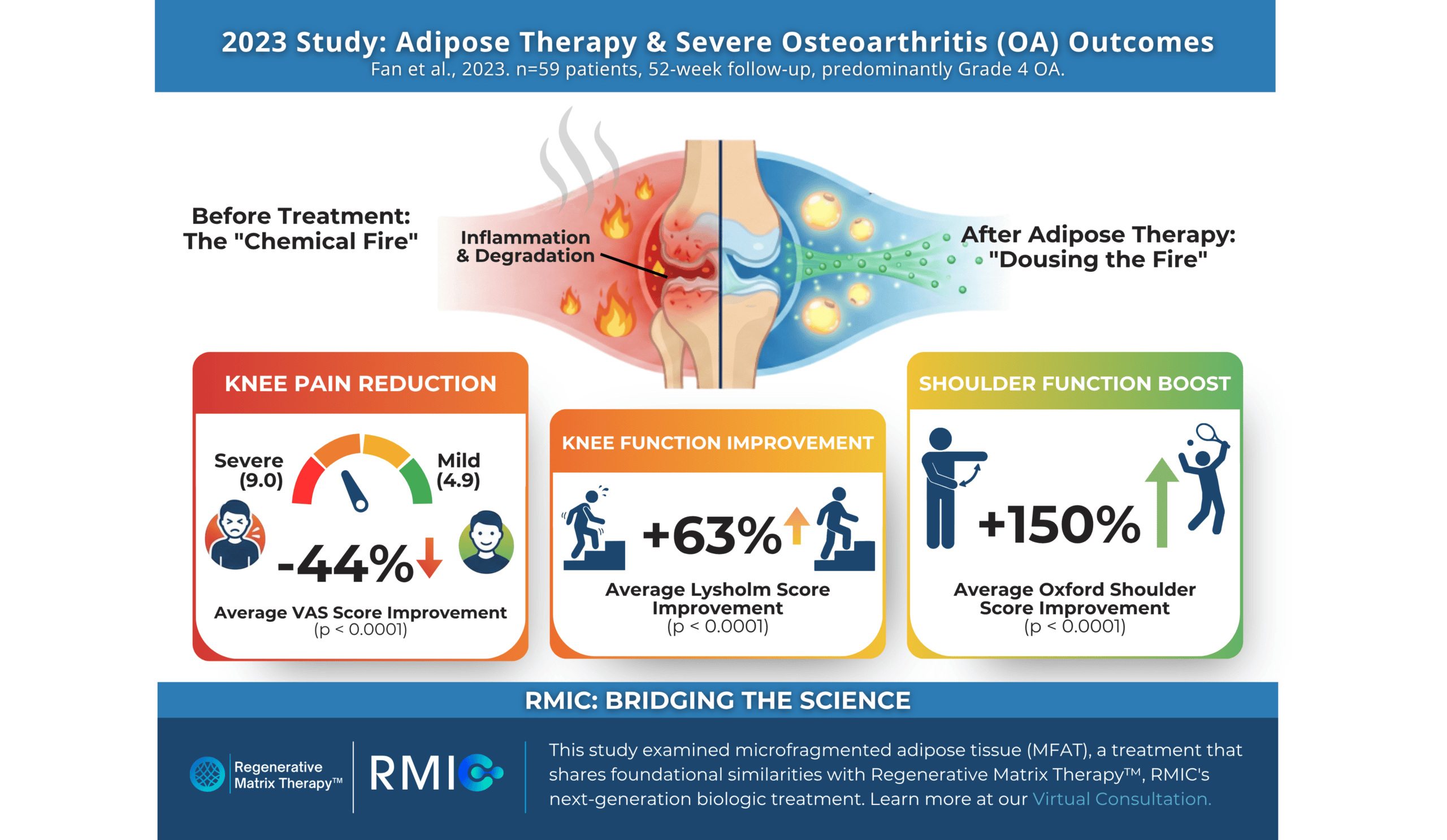
2023 Study: Less Pain One Year After Adipose Therapy in Severe Knee and Shoulder Osteoarthritis
When You’ve Been Told Your Knee Is Bone-on-Bone
There’s a conversation many people with knee osteoarthritis remember clearly. The X-ray goes up on the screen, the space in the joint has all but disappeared, and the phrase “bone-on-bone” enters your vocabulary for good. From that moment, the options can seem to narrow to two: keep managing the pain, or wait for a replacement.
Between those two sits the treatment gap. For people with the most advanced disease, it can feel as if that gap has already closed. Physiotherapy, anti-inflammatories and cortisone have usually been tried, and the relief, where it came, was often temporary. So the question gets sharper: if my knee is already this far gone, is it too late for an injection to help?
A 2023 prospective study published in Regenerative Medicine by Fan and colleagues looked at exactly that kind of patient. Researchers at a private clinic in the UK followed 59 consecutive patients — 50 knees and 13 shoulders — for one year after a single injection of their own processed adipose tissue — their own biology, placed back into the joint. What sets the study apart is who those patients were. Of the 50 knees, 47 (94%) were graded at the most severe stage of osteoarthritis.
This isn’t a study of early, mild arthritis. It’s a study of severe arthritis — joints at the far end of the disease.
Why Severe or Advanced Osteoarthritis Is a Harder Problem
Osteoarthritis isn’t simply wear and tear. As the authors describe it, the first damage to cartilage sets off a loss of balance inside the joint — the body’s own repair processes fall behind, and a smoldering, inflammatory state drives further breakdown. By the time a joint reaches Kellgren–Lawrence grade 4, the most severe grade and the one usually described as bone-on-bone, that imbalance has often been running for years.
Anti-inflammatory medication and cortisone injections can calm pain and swelling, though the relief is often temporary. Joint replacement is effective for many people, but it’s major surgery, and the authors point out that some patients still report pain after it. For younger patients, there’s also the prospect of a second operation later.
Adipose tissue — the fat your body stores — represents a different approach, one built on your own biology rather than on a drug or a lubricant. It is one of the body’s richest sources of biological material: beyond its mesenchymal stem cells, the authors note, it holds pericytes, cells from the lining of blood vessels, immune-regulating cells and a supporting extracellular matrix. The tissue used in this study was processed mechanically, without enzymes or laboratory culture, a method the authors describe as preserving its natural structure — and, with it, the full mix of biology described above.
This study doesn’t ask how that biology works. It asks the question that matters most to someone with severe disease — and it asks it of patients. Not whether adipose biology is interesting in the lab, but whether patients with joints this far along reported less pain and better function a year later.
Learn More About Regenerative Matrix Therapy™
Study Overview: One Injection, Mostly Bone-on-Bone Joints, One Year
Study Design: Prospective, single-arm observational study of consecutive patients at one private clinic in the UK. No control or comparison group. Patients were not blinded, and all outcomes were self-reported. Ethics approval from the MSK research ethics committee (MSK002101). No trial registration reported.
Participants: Patients with osteoarthritis of the knee or shoulder staged on X-ray as Kellgren–Lawrence grade 3 or 4, treated between October 2018 and January 2020. Knee patients: 28 men and 18 women, mean age 66.9 (range 44–82), mean BMI 32.0 (range 20–48). Shoulder patients: 4 men and 9 women, mean age 64.2 (range 44–72), mean BMI 30.1 (range 22–43). Other criteria and prior treatments were not reported.
Sample Size: 59 patients, 63 joints: 50 knees from 46 patients (4 treated in both knees) and 13 shoulders from 13 patients. 57 patients completed follow-up at the clinic and 2 by telephone. Six knees had a total knee replacement during the year (last scores carried forward).
Severity Mix: Knees: 47 of 50 at grade 4 (94%), 3 at grade 3. Shoulders: 9 of 13 at grade 4 (69%), 4 at grade 3.
Intervention: A single intra-articular injection of autologous micro-fragmented adipose tissue (MFAT), prepared with a closed, mechanical processing system. Fat was harvested from the lower abdomen under local anaesthetic, processed without enzymes or culture and filtered through a 500-micron mesh. About 6–8 ml was injected into the joint under ultrasound guidance. No other treatment, rehabilitation protocol or supplement was reported.
Follow-Up: Baseline, then 2, 6, 12, 24 and 52 weeks.
Endpoints: No single primary endpoint was designated; the primary aim was the effect of one injection on patient-reported pain and function. Knees: visual analogue scale (VAS) for pain (lower = better), Lysholm knee score and Oxford Knee Score (higher = better). Shoulders: VAS, QuickDASH (lower = better) and Oxford Shoulder Score (higher = better). Secondary aim: whether age, sex or BMI affected results. Results are reported as group medians.
Key Findings: Less Pain and Better Function at One Year in Advanced Arthritis
1. Every Pain and Function Score Was Better at One Year
The study’s aim was to test whether one injection improved patient-reported pain and function. It set no single primary endpoint; it tracked six scores, three for each joint. At 52 weeks, all six were significantly better than at baseline.
In the 50 knees, pain on the VAS fell by 4 points on a 10-point scale (44%; p <0.0001). The Lysholm score (limping, locking, swelling, stairs, squatting) rose by 24 points (63%; p <0.0001). The Oxford Knee Score — pain and difficulty with walking, stairs and getting in and out of a car — rose by 10 points (p <0.0001).
For many patients, a change of that size may be the difference between planning the day around a painful knee and getting through it with the knee in the background.
2. The Improvement Came in Almost All Severe, Bone-on-Bone Knees
Of the 50 knees treated, 47 (94%) were Kellgren–Lawrence grade 4, the most severe grade; the other 3 were grade 3. Patients averaged about 67 years old. These are the knees most often steered toward replacement.
The paper’s individual-patient charts show how widely the change was shared. At baseline, nearly every knee sat at the most painful end of the scale. By 12 weeks, nearly every one had moved toward the middle or the better end, and it stayed there through 52 weeks. The gain wasn’t carried by a few exceptional patients — it ran through almost the whole group. The paper doesn’t report how many patients crossed a set threshold, so this is a visual pattern, not a response rate.
The authors found no link between grade and results, though with so few grade 3 knees that couldn’t really be tested.
3. Relief Began Within Weeks and Largely Held at One Year
Knee pain and Lysholm scores were already significantly better at 2 weeks (p < 0.005), and the Oxford Knee Score by 6 weeks (p < 0.0001). All three peaked between 12 and 24 weeks.
Between 24 and 52 weeks, pain scores — and to a lesser extent Lysholm scores — crept back somewhat. That change was not statistically significant, and every score was still significantly better than baseline at one year. What happened after 52 weeks is unknown.
Only six of the 50 knees (~12%) went on to have a total knee replacement surgery during the study period — surgery that, the authors note, was available free through the UK’s National Health Service. For those knees, the last scores before surgery were carried forward into the analysis.
4. Shoulders, Most at the Most Severe Grade, Followed the Same Pattern
The study also treated 13 shoulders: 9 at grade 4 (69%) and 4 at grade 3. At 52 weeks, shoulder pain on the VAS was 3 points lower (38%), a statistically significant change. The QuickDASH score, which measures difficulty using the arm and shoulder in daily tasks, fell by 31 points (39%; p <0.0001). The Oxford Shoulder Score rose by 21 points (p <0.0001).
As in the knees, gains peaked around 24 weeks and pain crept back slightly afterward (not statistically significant).
5. Patients With Higher Body Weight Improved Less
In an exploratory analysis named among the study’s aims, higher body mass index (BMI) was linked with smaller improvements in knee pain and Lysholm scores at 52 weeks (both p < 0.05). The paper doesn’t say how large the effect was, and reports no such link for the Oxford Knee Score. Age and sex showed no relationship with results.
Higher body weight was common: knee patients averaged a BMI of 32.0. The paper didn’t establish why weight mattered. The study doesn’t show that heavier patients failed to improve, only that their improvement tended to be smaller.
6. The Paper Did Not Report Adverse Events
The authors call the treatment safe, but the paper gives no adverse-event data: no counts of joint swelling or pain, no harvest-site problems, no list of serious events.
What This Means for You
If you’ve been told your knee is bone-on-bone and that replacement is the next step, this study speaks directly to your situation. In a group where 94% of knees were at the most severe grade, pain and function were measurably better one year after a single injection of adipose therapy.
In this study of 50 knees, 47 of them bone-on-bone, pain was 4 points lower on a 10-point scale one year after a single adipose injection.
The change didn’t take long to appear. Pain and knee function were already better at two weeks, the gains peaked between 12 and 24 weeks, and they largely held to the one-year mark. The paper’s individual-patient charts suggest the improvement was spread across most of the group rather than concentrated in a few. Shoulders, most of them at the most severe grade, followed the same pattern, though in only 13 patients.
That matters. Severe or advanced arthritis is often treated as a closed door for anything short of surgery. This study suggests that door isn’t necessarily shut — not as a promise for any individual, but as a pattern across a group many would have written off.
The study also offers something patients rarely get: a hint about who did best. Patients with lower body weight tended to improve more on two of the three knee scores. That isn’t a verdict on whether a heavier patient should consider treatment. It’s one more piece of information for an honest conversation about expectations.
It’s just as important to be clear about what this study can’t tell you. Because every patient received the injection and knew it, and there was no comparison group, this study can’t show how much of the improvement came from the injection itself rather than from expectation or the natural ups and downs of arthritis. Patients sought out this treatment themselves. Follow-up lasted one year. Six knees went on to replacement during that year, and the paper did not report side effects.
Regenerative Matrix Therapy™ shares foundational similarities with, but is not identical to, the treatment studied. The findings of this study are directionally supportive of Regenerative Matrix Therapy™, RMIC’s next-generation adipose therapy. RMIC’s proprietary Regenerative Matrix Therapy™ protocol has been reviewed by Health Canada with no objection.
Start Your Virtual Consultation
Research Highlights (For Clinicians)
Study Citation: Fan F, Grant RA, Whitehead JP, Yewlett A, Lee PYF. “An observational study evaluating the efficacy of microfragmented adipose tissue in the treatment of osteoarthritis.” Regenerative Medicine. 2023;18(2):113–121. DOI: 10.2217/rme-2022-0110
Study Design: Prospective, single-arm observational cohort; consecutive patients; single private clinic (UK). Unblinded; self-selected patients. No control group. No trial registration reported. Funding not stated; authors declared no competing interests. Published as a Short Communication.
Population: 59 patients / 63 joints, KL 3–4 OA. Knee: 46 patients / 50 knees (4 bilateral, analysed as separate joints); 28 M / 18 F; age 66.9 ± 1.0 (44–82); BMI 32.0 ± 1.0 (20–48), F 34.8 vs M 30.0 (p = 0.0115); KL 3 = 3, KL 4 = 47. Shoulder: 13 patients / 13 shoulders; 4 M / 9 F; age 64.2 ± 2.4 (44–72); BMI 30.1 ± 1.7 (22–43); KL 3 = 4, KL 4 = 9. Values mean ± SEM. Other inclusion/exclusion criteria and prior treatments not reported.
Intervention: Single intra-articular autologous MFAT (Lipogems®). Lower-abdominal harvest under local anaesthetic (5 ml 1% lidocaine) after ~200 ml tumescent infiltration; mechanical processing in closed system; 500-micron filtration; 6–8 ml injected under US guidance. No co-interventions or rehabilitation protocol reported.
Analysis: Data non-normal (Anderson–Darling). Knee: mixed-effects analysis with Tukey (methods; Fig 1 legend states RM one-way ANOVA). Shoulder: Friedman with Dunn. LOCF for 6 knees after TKA. Medians ± 95% CI; baseline and endpoint values shown graphically only.
Effect Sizes at 52 Weeks (change from baseline, medians):
- Knee VAS: −4 points (44%); p < 0.0001
- Lysholm: +24 points (63%); p < 0.0001
- Oxford Knee: +10 points; p < 0.0001 (paper prints 33%, which does not reconcile with Fig 1F)
- Shoulder VAS: −3 points (38%); text p < 0.0001, Fig 2B marks p < 0.005
- QuickDASH: −31 points (39%); p < 0.0001
- Oxford Shoulder: +21 points; p < 0.0001
Time Course: Knee VAS and Lysholm significant at 2 weeks (p <0.005); Oxford Knee from 6 weeks. Shoulder VAS from 6 weeks (p <0.05); QuickDASH and Oxford Shoulder from 12 weeks (p <0.0005). Peak 12–24 weeks; VAS regression 24–52 weeks in both joints, NS.
MCID / Responder Rates: Not reported.
Predictors (exploratory secondary aim): Inverse correlation of BMI with knee VAS and Lysholm improvement at 52 weeks (both p <0.05); no coefficient reported; not reported for Oxford Knee or shoulders. No relationship with sex, age or KL stage (KL 3 n = 3).
Conversion to Surgery: 6 of 50 knees (~12%) underwent TKA during follow-up (NHS-funded); timing not reported.
Safety: Adverse events not reported.
Limitations:
- Single-arm, unblinded design; no comparator or placebo control; self-selected population
- Subjective PROMs only; no imaging or biological markers; MSC content of the injectate not verified
- 52-week follow-up; numbers at each timepoint not tabulated
- No designated primary endpoint; parametric tests applied to non-normal data; bilateral knees treated as independent
- Internal inconsistencies (Oxford Knee percentage; shoulder VAS p-value; BMI range 20–48 in Table 1 vs 22–48 in Fig 1)
- Adverse events not reported
Learn More About Regenerative Matrix Therapy™
See More Conditions We Treat
Disclaimer
This content is intended for educational purposes only and does not constitute medical advice or a substitute for consultation with a qualified healthcare provider. Individual results vary based on disease severity, anatomy, and adherence to post-care protocols. Regenerative Matrix Therapy™ shares foundational similarities with, but is not identical to, the treatment studied.
Why Choose Regenerative Matrix Therapy™ With RMIC?
Regenerative Matrix Therapy™ is RMIC’s next-generation adipose therapy, an advanced treatment that uses your own tissue and is delivered through a standardized, physician-led protocol. RMIC’s proprietary Regenerative Matrix Therapy™ protocol has been reviewed by Health Canada with no objection. If severe knee or shoulder osteoarthritis has left you weighing a replacement you’re not ready for, we invite you to explore whether you’re a candidate.