
2021 Study: Adipose Therapy Eased Knee Osteoarthritis Pain Through Two Years in Adults 60 and Older
When You’re Past 60 and Wondering If It’s Too Late
There is a point many people with knee osteoarthritis reach somewhere after 60. The knee has been sore for years, the stairs take more planning than they used to, and the conversation with the doctor starts to drift toward a replacement — or toward waiting until it’s bad enough for one. Somewhere in that conversation, a quieter question surfaces: at my age, is an injection still worth trying, and would the relief even last?
That is the treatment gap as many older patients live it. Physiotherapy, anti-inflammatories and cortisone have usually been tried, and the relief, where it came, was often temporary. Knee replacement is effective for many people, but it is major surgery with a long recovery, and not everyone is ready for it.
A 2021 retrospective study published in International Orthopaedics by Gobbi and colleagues looked at exactly that group. Five orthopaedic and regenerative medicine centres in several countries reviewed the records of 75 patients aged 60 and older — 120 knees in all — who received a single injection of adipose tissue drawn from their own biology and were followed for two years. The average patient was nearly 70.
The result that stands out is a simple count. Nearly 9 in 10 knees did not need a repeat injection or a replacement in the two years after just one injection.
Why Age Changes the Question
Osteoarthritis becomes more common with every decade. The authors describe a joint that, with age, gradually loses its ability to keep up with everyday stress: cartilage thins, the joint recovers less well from injury, and pain and stiffness build. By your late 60s, that process has often been running for a long time.
That is why age so often reshapes the conversation. A younger patient may be told to wait. An older patient may be told it’s time for a replacement — or that the knee is simply too worn for anything else to make a difference. Neither message leaves much room in between. Age narrows the options.
Adipose tissue — the fat your body stores — offers a different starting point, one built on your own biology rather than on a drug or a lubricant. It is one of the body’s richest sources of biological material, holding mesenchymal stem cells, pericytes and the supporting tissue around them. In this study, the tissue was harvested from the abdomen or from just above the buttock, then processed mechanically — without enzymes or laboratory culture — before being injected back into the knee. Your own biology, returned to the joint.
This study doesn’t ask how that biology works. It asks something more practical, of the patients most often told they are too old: did their knees hurt less, and did it last? Not whether adipose therapy is promising in principle, but whether it held up across two years in real patients in their 60s and 70s.
Learn More About Regenerative Matrix Therapy™
Study Overview: One Injection, Patients 60 and Older, Two Years
Study Design: Retrospective, multi-centre, open-label study of consecutive patients, drawn from the patient registries of five international orthopaedic surgery and regenerative medicine centres. No control or comparison group (Level 4 evidence). Severity was graded by independent musculoskeletal radiologists.
Participants: Adults aged 60 or older with at least three months of knee pain and osteoarthritis confirmed on X-ray or MRI, treated between September 2014 and April 2018. Mean age 69.6; 65.3% women; mean BMI 28.4. Patients with a knee injection, anti-inflammatories or steroids in the six weeks before treatment were excluded. One in five knees (20.8%) had had earlier knee surgery, such as arthroscopy, meniscus repair or ACL reconstruction.
Sample Size: 75 patients, 120 knees; 44 patients were treated in both knees at the same time. At least 24 months of follow-up was required for inclusion. Pain and function results are reported for the 106 knees that needed no repeat injection or replacement.
Severity Mix: Kellgren–Lawrence grade 2: 15.1%; grade 3: 56.3%; grade 4, the most severe grade, usually described as bone-on-bone: 28.6%.
Intervention: A single injection of autologous micro-fragmented adipose tissue (MFAT), prepared with a closed, mechanical processing system. Fat was harvested from the abdomen or above the buttock under local or general anaesthesia; 60–120 cc of tissue and fluid was collected, and most knees received 5–9 ml. Some knees were injected during an arthroscopic procedure; the paper does not say how many. Afterward, patients used ice and acetaminophen, avoided anti-inflammatories and kept to low-impact exercise; no supervised physiotherapy was required.
Follow-Up: Before treatment, then at 6, 12 and 24 months. Knees that needed no further treatment were followed for 24 to 39 months.
Endpoints: Primary: the Knee Injury and Osteoarthritis Outcome Score (KOOS), five subscales scored 0–100 — pain, other symptoms, activities of daily living, sport and recreation, and knee-related quality of life (higher = better). Also measured: treatment failure, defined as a repeat injection or a knee replacement within two years; the share of knees reaching a meaningful improvement on each subscale; and the patient factors linked with results.
Key Findings: Nearly 9 in 10 Knees Needed No Repeat Injection or Replacement at Two Years
1. Vast Majority of Knees Needed No Repeat Injection or Replacement After Two Years, and Pain Improved by Six Months
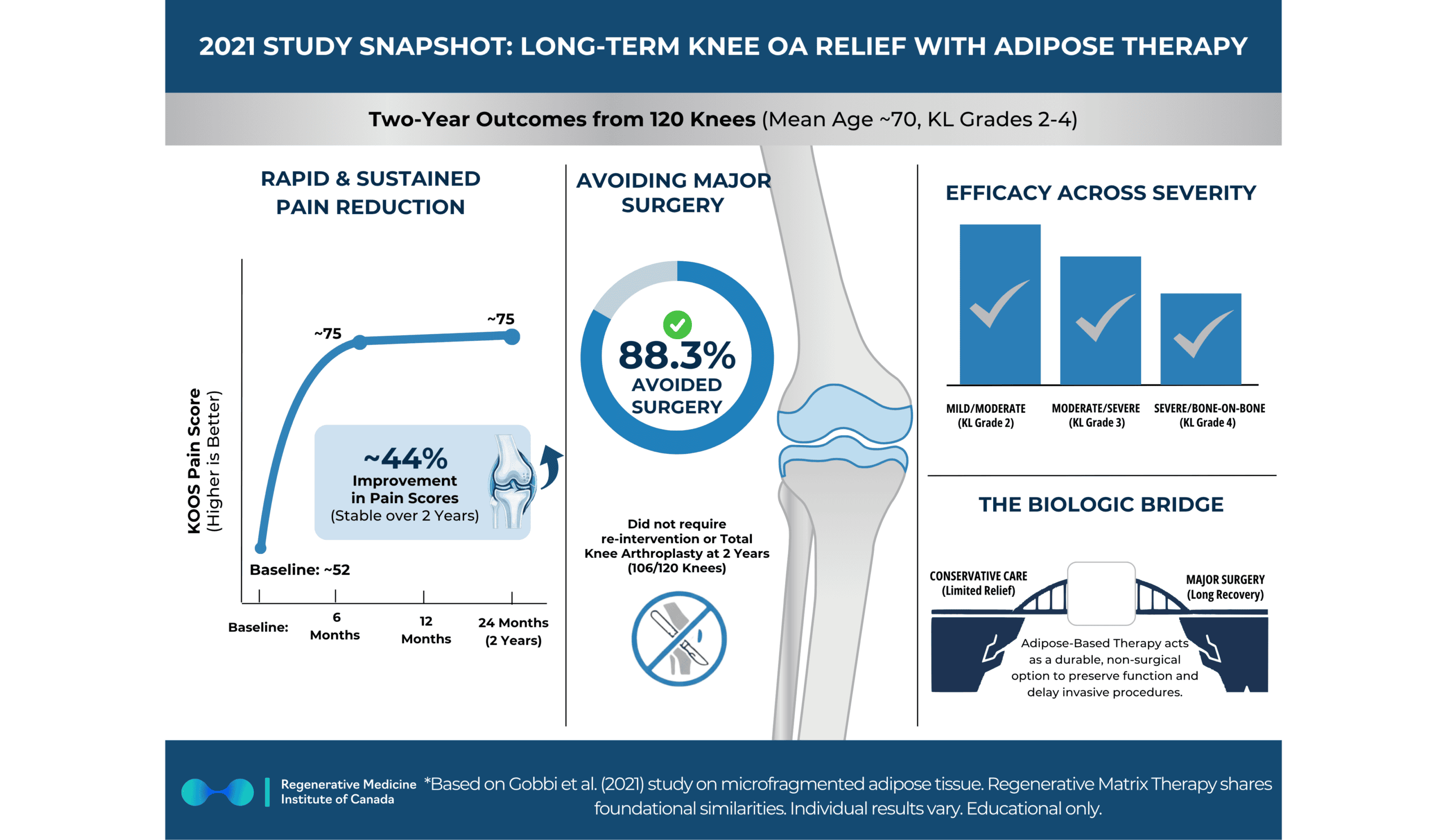
Two years after a single adipose therapy injection, 106 of 120 knees (88.3%) had needed neither a repeat injection nor a knee replacement. In those knees, KOOS pain scores improved significantly by six months and stayed at that level through 24 months.
On the KOOS pain scale, a higher number means less pain. Read from the paper’s chart, the average pain score in those knees rose from about 52 before treatment to about 75 out of 100 at 24 months — a gain of ~23 points (~44%).
For many patients, a change of that size may be the difference between a knee that decides how far you walk and one that mostly stays in the background.
2. Two in Three Knees Cleared a Bar Set by Knee-Replacement Patients
The study counted knees that improved by at least the minimal clinically important difference (MCID) — the smallest change patients recognize as meaningful — using a threshold taken from knee-replacement patients. In the paper’s words, responders were “those treatments that reported a difference in pre-treatment and 24-month follow-up KOOS scores that exceeded the minimal clinically important difference.”
Among the knees that needed no further treatment, 65.7% cleared the threshold for pain at 24 months — about two in three. For activities of daily living — stairs, rising from a chair, walking, getting in and out of a car — the figure was 72.4%, and for knee-related quality of life it was 74.3%. About one in three knees didn’t reach the pain threshold.
That bar was not set by other injection patients. It was set by people recovering from knee replacement.
3. The Improvement Arrived Early and Held Steady to Two Years
Pain scores improved significantly by the six-month check, then levelled off: read from the paper’s chart, about 73 at 6 months and about 75 at both 12 and 24 months. The authors describe the improvement as plateauing through 24 months in every grade of knee osteoarthritis.
That’s the shape patients hope for — not a spike that fades, but a level that holds.
The authors noted that at 24 months many knees, especially at grades 3 and 4, still had pain scores below the level patients typically describe as acceptable, and they recommended following patients to five years.
4. Every Grade Improved, and Grade 2 Knees Improved Most
In an exploratory analysis by severity, knee pain improved at every Kellgren–Lawrence grade, but grade 2 knees had the best pain results (p = 0.001). Read from the paper’s chart, average KOOS pain scores moved as follows:
- Grade 2: about 61 before treatment → about 89 at 24 months
- Grade 3: about 55 → about 72
- Grade 4 (bone-on-bone): about 43 → about 62
Bone-on-bone knees started with the most pain and finished below milder knees. But they still rose by ~19 points (~44%) — and more than a quarter of the knees in this study were at that grade.
5. Who Was More Likely to Need Further Treatment
In an exploratory analysis, the factors linked with needing a repeat injection or replacement were male sex, higher body weight, older age — even within a group already 60 and over — and earlier knee surgery.
There was an encouraging detail for people with earlier knee surgery. Among knees that needed no further treatment, those with earlier surgery improved about as much as those without: read from the paper’s chart, from about 52 to about 76, against about 53 to about 72.
These factors don’t decide who should be considered. They belong in an honest conversation about expectations.
6. Side Effects Lasted Days, and None Were Severe
Of the 75 patients, 37 (49%) had pain at the harvest site that needed non-narcotic pain relief for an average of three days, and 21 (28%) had swelling or bruising there for an average of seven days. 10 patients (13%) had knee swelling lasting an average of six days. No severe adverse events occurred.
What This Means for You
If you’re past 60 and have been told your knee is too worn for anything short of surgery, this study speaks to your situation. In a group whose average age was nearly 70, most knees (~88%) needed neither a repeat injection nor a replacement two years after a single injection of adipose therapy, drawn from the patient’s own biology, and in those knees pain improved by six months and held through 24 months.
In this study of 120 knees in patients aged 60 and older, 106 (~88%) had needed neither a repeat injection nor a knee replacement two years after one adipose injection.
The improvement did not take long to arrive, and it did not fade within the two years. About two in three of those knees cleared a pain threshold borrowed from knee-replacement patients. Every grade of arthritis improved, with milder knees improving most, and knees that had been operated on before kept pace with the rest.
Age is often treated as the point at which the treatment gap closes. This study suggests that, for many patients in their 60s and 70s, it hadn’t — a pattern seen across the study group.
The study also hints at who tended to do best: women, people with lower body weight, knees without earlier surgery and knees with milder arthritis. That’s useful for setting expectations about who is most likely to improve, but it isn’t a reason to rule anyone in or out.
Regenerative Matrix Therapy™ shares foundational similarities with, but is not identical to, the treatment studied. The findings of this study are directionally supportive of Regenerative Matrix Therapy™, RMIC’s next-generation adipose therapy. RMIC’s proprietary Regenerative Matrix Therapy™ protocol has been reviewed by Health Canada with no objection.
Start Your Virtual Consultation
Research Highlights (For Clinicians)
Study Citation: Gobbi A, Dallo I, Rogers C, Striano RD, Mautner K, Bowers R, Rozak M, Bilbool N, Murrell WD. “Two-year clinical outcomes of autologous microfragmented adipose tissue in elderly patients with knee osteoarthritis: a multi-centric, international study.” International Orthopaedics. 2021;45:1179–1188. DOI: 10.1007/s00264-021-04947-0
Study Design: Retrospective, multi-centre (5 international sites), open-label registry study; consecutive patients; Level 4. No control group. Registry IRB approval at each site; no trial registration. KL grading by independent MSK radiologists; data entry by independent investigators; analysis by an independent statistician. Self-funded.
Population: 131 screened; 48 ineligible (47 aged < 60; 1 not knee OA); 8 eligible not included (3 BMAC, 3 no follow-up, 2 enrolment failure). 75 patients / 120 knees (44 simultaneous bilateral; 2 patients treated more than once). Age 69.6; 65.3% F; 80% non-smokers; BMI 28.4. KL 2 / 3 / 4 = 15.1% / 56.3% / 28.6% (reconciles with 119 knees, not 120). Prior knee surgery 20.8%. Baseline KOOS: Pain 52.4; Symptoms 54.1; ADL 54.6; Sport/Rec 26.7; QOL 29.6; total 48.4 (all below PASS). Excluded: concomitant surgery other than debridement; inflammatory arthritis, gout; IA injection, NSAIDs or steroids within 6 weeks. Minimum 24M follow-up required for inclusion.
Intervention: Single autologous MFAT (Lipogems®). Abdominal (supine) or supra-gluteal (prone) harvest under local or general anaesthesia; up to 300 ml tumescent; 60–120 cc aspirated via 4 mm cannula; closed, low-pressure mechanical processing. Dose: 5 cc 30.8%, 6 cc 18.3%, 7 cc 30.0%, 9 cc 17.5%, 21 cc 3.3% (21 cc excluded from dose analysis as outliers). US-guided supra-patellar injection, injection under arthroscopic control during a surgical procedure, or multiple intra-/extra-articular injections, at surgeon discretion; numbers per route not reported. Post-care: ice, acetaminophen, no NSAIDs; non-impact exercise; no supervised physiotherapy or brace.
Analysis: Mixed-effects model (patient as random factor) on KOOS-Pain with failed treatments removed; Dunnett post hoc comparisons. Weighted (1:7) binary logistic regression for failure; logistic models for < MCID and > PASS. No imputation or sensitivity analysis. Post hoc power analysis.
Effect Sizes (KOOS-Pain, non-failed knees; means shown in figures only, values read from charts):
- Overall (Fig 2a): ~52 → ~73 (6M) → ~75 (12M) → ~75 (24M); significant pre-treatment to 6M, stable to 24M
- By KL (Fig 2b): KL 2 ~61 → ~89; KL 3 ~55 → ~72; KL 4 ~43 → ~62 (peak ~67 at 12M); KL 2 best, p = 0.001
- By prior surgery (Fig 2c): yes ~52 → ~76; no ~53 → ~72
- Other KOOS subscale means not reported. VAS collected; not reported
MCID / Responder Rates (24M, non-failed knees): Responder = change from pre-treatment to 24M exceeding the subscale MCID defined by Lyman et al. for TKA patients. Pain 65.7%; Symptoms 64.8%; ADL 72.4%; QOL 74.3% (printed “74.3.7%”). Denominator not stated; rates reconcile with ~105 knees (e.g., 69/105). Counting the 14 failures as non-responders, pain ~57.5% (~69/120). Non-response for pain associated with higher baseline KOOS-ADL (p = 0.014) and 7 cc vs 9 cc dose (p < 0.001).
PASS: KOOS-Pain at 24M dichotomized at PASS (Connelly et al., 3 years post-TKA). Rate not reported; modelled probability of > PASS fell with KL grade (Fig 4). Associated: higher baseline KOOS-Pain (p = 0.001); KL 4 vs 2 (p = 0.037).
Treatment Failure (re-injection or arthroplasty within 24M): 14 of 120 knees (11.7%; 9 patients). Split between re-injection and arthroplasty not reported as counts. Failure group: 64.3% male; mean age 70.7; KL 4 57.1%, KL 3 35.7%, KL 2 7.1%; mean BMI 33.2. Significant predictors (weighted logistic regression): age (p = 0.01), male sex (p < 0.001), BMI (p < 0.001), previous surgery (p = 0.009). Reported coefficients and effect estimates do not reconcile for age and BMI (Table 2) or in Table 3.
Safety (per patient, n = 75): Donor-site pain requiring non-narcotic analgesia, mean 3 days: 37 (49%). Donor-site swelling/bruising, mean 7 days: 21 (28%). Prolonged knee swelling, mean 6 days: 10 (13%). No severe AEs.
Limitations:
- Retrospective, open-label, single-arm design; no control; regression to the mean not addressed
- Failed treatments excluded from outcome analyses; minimum 24M follow-up required for inclusion
- KOOS means shown graphically only; VAS not reported; responder denominators not stated
- Injection route, including injection during arthroscopy, not quantified
- Simultaneous bilateral treatment in 44 patients
- Internal inconsistencies (KL percentages vs n = 120; coefficients vs effect estimates)
- 24M endpoint; authors recommend 5-year follow-up
Learn More About Regenerative Matrix Therapy™See More Conditions We Treat
Disclaimer
This content is intended for educational purposes only and does not constitute medical advice or a substitute for consultation with a qualified healthcare provider. Individual results vary based on disease severity, anatomy, and adherence to post-care protocols. Regenerative Matrix Therapy™ shares foundational similarities with, but is not identical to, the treatment studied.
Why Choose Regenerative Matrix Therapy™ With RMIC?
Regenerative Matrix Therapy™ is RMIC’s next-generation adipose therapy — an advanced treatment that uses your own tissue, delivered through a standardized, physician-led protocol. RMIC’s proprietary Regenerative Matrix Therapy™ protocol has been reviewed by Health Canada with no objection. If knee osteoarthritis has you weighing a replacement you’re not ready for, whatever your age, we invite you to explore whether you’re a candidate.